Opinion: Syrian Conflict Starting to Resemble Mini-World War

If you enjoy playing with dominoes, you know that a carefully laid out pattern of the toys can make quite an impressive display once the first one is knocked over. One after another, dominoes fall at racing speed. Similarly, if you’re a history buff, you may recall that World War …

What Biblical Prophecy Says about Syria, Part 2: Damascus in Ruins

The news today can seem like one unrelated event after another. Or perhaps like a whole slew of repeated events in which the same sad problems just resurface. But what if the things happening today are more than that? What if they’re part of a thousands-years-old process reaching its climax? …

Hamas Hopes Ties Deepen with Iran in Opposition to Israel

Here’s a recipe for Middle East conflict: Take one terrorist-sponsoring dictatorship with money and hate to burn, add a local terror group, add water and mix well. Ok, so the water isn’t necessary. But Hamas—Israel’s most antagonistic terror enemy in the last 20 years—is looking for deeper ties with Iran …

Debunking the Myths about Iran’s New President

There’s a special secret for crooked salesmen who sell the lemon of the car variety, or sneaky street vendors who cheat unsuspecting tourists, and it’s called desire. When the buyer wants something badly enough, they’re not likely to ask the right questions or do the research needed to make a …

Recent Articles:

Debunking the Myths about Iran’s New President

June 18, 2013 Iran Nuclear Program, News
Really moderate, or just for show? Iranian President Rouhani. Illustrative. FEMA/Marty Bahamonde.

Really moderate, or just for show? Iranian President Rouhani. Illustrative. FEMA/Marty Bahamonde.

There’s a special secret for crooked salesmen who sell the lemon of the car variety, or sneaky street vendors who cheat unsuspecting tourists, and it’s called desire. When the buyer wants something badly enough, they’re not likely to ask the right questions or do the research needed to make a wise decision. The rose-colored glasses are on, even if the plant being sold is nothing but a thorn bush.

For years, the West has wanted and hoped that Iran would moderate and open up. The election of Hassan Rouhani as Iran’s new “moderate” president has garnered many headlines and raised still more eyebrows. But the thorns on that plant may not be of the rose variety. Let’s take a closer look.

Myth 1: Rouhani is an outsider

Ever had a friend who was close enough they could critique you to your face? That’s what Rouhani seems to be for Iranian Supreme Leader Ayatollah Ali Khamenei. Despite Rouhani’s much publicized reaching out to the Iranian opposition movement and his critiques of Iran’s government, his relationship with Iran’s dictator is long-lived. Khamenei is a radical, and so therefore the moderate Rouhani should be his strongest opponent—right? Wrong.

First, Rouhani’s own bio on the think-tank he heads shows he has been the Representative of Supreme Leader Khamenei to the Supreme National Security Council since 1989. In other words, he’s not just on an insider’s committee—he represents Khamenei to the insider council. Wow.

Next, if a news report of a suicide note from Rouhani’s son is to be believed, Iran’s new president has been publicly supportive of Khamenei, at least in the past. Ynet, republishing the suicide note originally reported by al-Sharq al-Awsat, quoted Rouhani’s son as saying, “I am ashamed to live in such environment where I’m forced to lie to my friends each day, telling them that my father isn’t part of all of this… It makes me sick seeing you, my father, kiss the hand of Khamenei.”

Maybe Rouhani isn’t a Khamenei puppet. But he’s not his enemy either.

Myth 2: Rouhani is a genuine reformist

It’s always helpful when the other side makes points for you. “Rouhani is not himself a reformist,” sounds like a phrase you might here from an American conservative. In truth, those words were penned by a handful of academics in a commentary on Al-Jazeera praising the Iranian elections—a commentary republished by Iran’s semi-official Fars News Agency. The academics further note that Rouhani’s a cleric. Need we say more?

Rouhani is not himself a reformist. Now an American conservative has said it too.

Myth 3: Rouhani will compromise on the nuclear issue

The one shred of hope attaching itself to Rouhani was his tenure as Iran’s negotiator with the West on the nuclear matter. During his time, Iran actually appeared to halt some of its nuclear work. To this day, it’s considered one of the only success moments for the West in the Iran nuclear crisis.

Was it due to Rouhani? Or was it due to the US-launched Iraq war that came that same year and scared all the Middle East into believing that the US was coming for them next?

At best, it appears it was the latter. Because an article on Rouhani by the Gatestone Institute cites a newspaper article that makes Rouhani sound pretty sneaky.

The UK’s Daily Telegraph in 2006 cited a regime journal quoting Rouhani as telling clerics and academics that they used the negotiations with the West to provide cover for nuclear progress.

“When we were negotiating with the Europeans in Teheran we were still installing some of the equipment at the Isfahan [nuclear] site,” Rouhani was quoted as saying. “There was plenty of work to be done to complete the site and finish the work there. In reality, by creating a tame situation, we could finish Isfahan.”

So there’s the last hope. Unless Rouhani has changed for the better in the last seven years, we have a moderate-looking politician who is actually:

  1. A trusted representative of an extremist dictator.
  2. A cleric described by Iranians as no reformist himself.
  3. A sneak who tricked the West in his last opportunity to negotiate with them about the Iranian nuclear program.

Take the rose-colored glasses off. Those thorns aren’t on a flower stem.

Hamas Hopes Ties Deepen with Iran in Opposition to Israel

June 17, 2013 Peace and Conflict, Terrorism
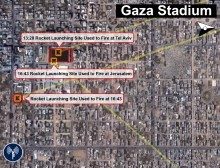
IDF image of Beersheba damage from Gaza rockets. Photo Courtesy of IDF Spokesperson.

IDF image of Beersheba damage from Gaza rockets. Photo Courtesy of IDF Spokesperson.

Here’s a recipe for Middle East conflict: Take one terrorist-sponsoring dictatorship with money and hate to burn, add a local terror group, add water and mix well. Ok, so the water isn’t necessary. But Hamas—Israel’s most antagonistic terror enemy in the last 20 years—is looking for deeper ties with Iran after Hassan Rouhani was elected president there. And their mutual hate of Israel is key motivation.

“For sure we hope that the Iranian support will continue especially that Hamas encourages Iran against Israel,” senior Hamas party leader Ahmad Yousef told the Ma’an News Agency. Iran has been a financial supporter of Hamas in the past, and Ma’an reported that Yousef hopes the relationship will only get better under Rouhani. … Continue Reading

Israel on ‘Moderate’ Iran President: Watch Actions, Not Words

June 16, 2013 Iran Nuclear Program, News
Really moderate, or just for show? Iranian President Rouhani. Illustrative. FEMA/Marty Bahamonde.

Really moderate, or just for show? Iranian President Rouhani. Illustrative. FEMA/Marty Bahamonde.

Iran has a new president—Hassan Rouhani—who is presenting himself as rejecting extremism. Before the world gets too excited about Iran electing a “moderate,” however, Israel has a warning: It’s actions that count, not what they say. Considering nuclear weapons and global terrorism are in play here, the risk of accepting Iran too quickly is enormous.

“Fifteen years ago, the election of another president, also considered a moderate by the West, led to no change in these aggressive policies,” Israeli Prime Minister Benjamin Netanyahu said. “…Iran will be judged by its actions. If it continues to insist on developing its nuclear program, the answer needs to be very clear—stopping the nuclear program by any means.” … Continue Reading

Audio: How to Avoid A War

June 16, 2013 Audio, Peace and Conflict, Syria
Is the speech mightier than the sword? US President Obama. Illustrative. Photo Courtesy of UN Photo/Mark Garten

Is the speech mightier than the sword? US President Obama. Illustrative. Photo Courtesy of UN Photo/Mark Garten

The Obama Administration made bold announcements about Syria. But they didn’t say enough. If you’re concerned about the US going to war again in the Middle East, here’s what we should be doing that just might prevent that from being necessary. To hear how, just hit play:


Will the US Send Weapons to Syrian Rebels?

June 14, 2013 Syria
Obama's talking loud, but how big a stick is he carrying? Illustrative. Photo Courtesy of Official White House Photo by Pete Souza

Obama’s talking loud, but how big a stick is he carrying? Illustrative. Photo Courtesy of Official White House Photo by Pete Souza

Despite announcing that they are all but certain the Syrian regime has used chemical weapons on its own people, it remains unclear if the US is going to arm the rebels in Syria or set up a no-fly zone on their behalf. The Daily Beast asked US government officials if President Barack Obama was going to send weapons to the rebels now, and actually got different answers depending on which official was asked.  … Continue Reading

US Confident Syrian Regime Crossed Red Lines with Chemical Weapons

June 13, 2013 News, Syria
US troops never going to Syria? Soldier training with gas mask. Illustrative. Photo courtesy of Mr James Brabenec (IMCOM)

US troops never going to Syria? Soldier training with gas mask. Illustrative. Photo courtesy of Mr James Brabenec (IMCOM)

Looks like the Syrian regime has indeed crossed the chemical weapons red line, but not much is changing for the United States’ involvement in the Syrian civil war. In other words, the threats of the past don’t mean war now.  US official Ben Rhodes announced on Thursday that the American intelligence community has “high confidence” that the Syrian regime has used chemical weapons “on a small scale” on multiple occasions over the last year.

Rhodes, in a statement released by the White House, said, “the use of chemical weapons violates international norms and crosses clear red lines that have existed within the international community for decades.” So far, the US intelligence community estimates 100-150 people have died from the chemical weapons. … Continue Reading

Stay informed! Enter your email address to receive notifications of new posts by email.

Want to go to the Middle East for less than a gallon of gas?

You can get all the news and analysis with an In Depth Subscription today for just $2 a month! To get this automatically renewing monthly subscription, simply fill out and submit the following form. Start your subscription today!

Follow The Mideast Update on Twitter

Like The Mideast Update on Facebook

Categories

Books I’d Read